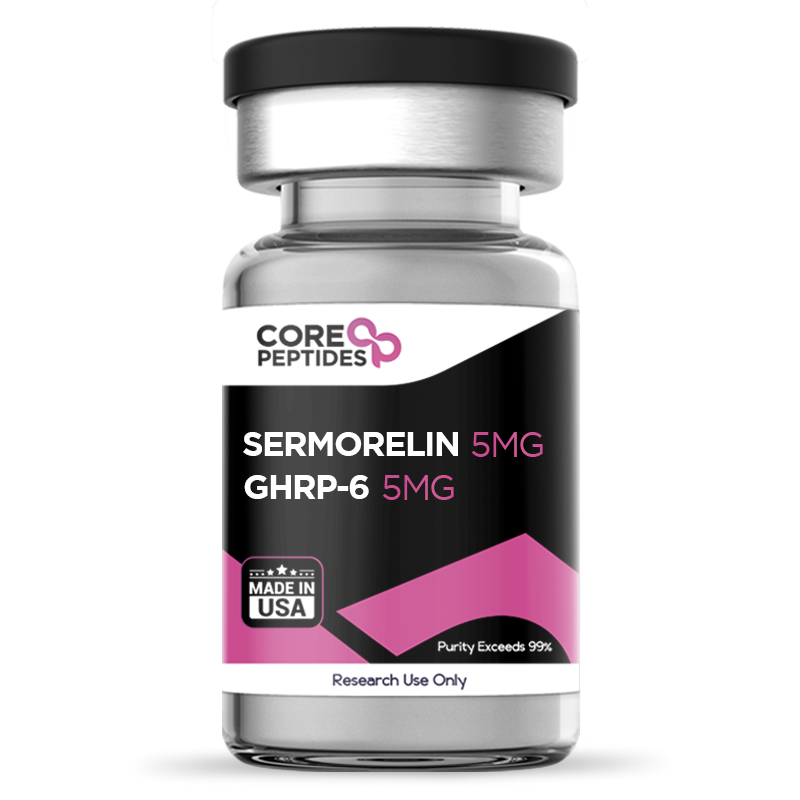
Sermorelin & GHRP-6 Blend
Sermorelin and GHRP-6 are synthetic research peptides that both appear to interact with pituitary cells, albeit via different receptors. Sermorelin is an analog of the endogenous Growth Hormone-Releasing Hormone and is thought to act mainly at the classical GHRH receptor on anterior pituitary cells. Activating them is thought to lead to growth hormone release from pituitary cells, potentially.
GHRP-6, by contrast, is classified as a growth hormone secretagogue (GHS) and appears to interact with ghrelin-sensitive receptors such as GHS-R1a, which are distinct from the GHRH receptor and may prefer partially separate intracellular signaling pathways. Activating them may also lead to growth hormone release from pituitary cells.
Because these two receptor families seem to converge on the same GH-producing cells while using different upstream inputs, investigators have posited that combining Sermorelin and GHRP-6 in experimental models might provide a stronger or more nuanced stimulus to somatotroph function than either peptide alone.
Chemical Makeup
Other Known Titles
- Sermorelin: GRF 1-29 NH2
- GHRP-6: SKF-110679, growth hormone-releasing hexapeptide
Molecular Weight:
- Sermorelin:93 g/mol
- GHRP-6:03 g/mol
Molecular Formula:
- Sermorelin: C149H246N44O42S
- GHRP-6: C46H56N12O6
Research and Clinical Studies
Sermorelin & GHRP-6 Structure
Sermorelin is posited to be a 29–amino acid fragment corresponding to the N-terminal portion of endogenous GHRH, with a C-terminal amidation that may help stabilize the molecule. Experimental work such as that of Clark et al. suggests that this fragment apparently retains full affinity and activation potential for pituitary GHRH receptors.(1) Consequently, this receptor activation is thought to drive cAMP-linked pathways that support growth hormone synthesis and release from pituitary cells. Thus, they commented that Sermorelin potentially “accelerates growth and increases pituitary GH content.”
Research suggests that rather than being a GHRH analog, GHRP-6 appears to be a hexapeptide designed to interact with a different set of receptors on pituitary cells, referred to as ghrelin receptors. Yet, researchers such as Bowers et al. reveal that the peptide is not an analog to ghrelin, but appears derived from an opioid receptor agonist referred to as met-enkephalin.(2) The difference is that GHRP-6 is modified so that it loses opioid receptor affinity and gains ghrelin receptor affinity. Before the discovery of ghrelin receptors, these were actually termed growth hormone secretagogue 1a receptors (GHS-R1a), and the molecules that might interact with them, like GHRP-6, are suggested to be growth hormone secretagogues (GHSs).
Sermorelin & GHRP-6 Affinity Towards Pituitary Cell Receptors
As mentioned, Sermorelin and GHRP-6 may both interact with pituitary cells to stimulate growth hormone release, but appear to achieve that via different receptors and cellular pathways. Research by Culhane et al. suggests that Sermorelin may activate the GHRH receptors similarly to endogenous GHRH.(3) This may involve the activation of an intracellular messenger called cyclic AMP (cAMP) and the kinase PKA (protein kinase A), which together may switch on the cellular machinery that moves growth-hormone–containing vesicles to the membrane for release.
On the other hand, GHRP-6 appears to target pituitary cells through the GHS-R1a receptor. Studies such as those by Yin et al. indicate that ligands of this receptor may favor activation of another messenger called phospholipase C.(4) PLC then is thought to cleave membrane PIP₂ into second messengers such as IP₃ and DAG. IP₃ may move toward intracellular calcium stores and trigger calcium release into the cytosol, while DAG remains in the membrane and potentially activates PKC (protein kinase C). Similar to PKA, PKC, in combination with the increased calcium release, may mobilize growth hormone-containing granules toward the plasma membrane of pituitary cells and promote their discharge.
Sermorelin & GHRP-6 Potential for Growth Hormone Release
Research on pituitary cells suggests that exposure to Sermorelin may induce an upregulation of growth hormone synthesis and release capacity. In experiments by Vittone et al., 12-hour mean growth hormone concentrations apparently rose from about 1.1 ± 0.9 µg/L to roughly 2.2 ± 1.9 µg/L, while the integrated 12-hour growth hormone output increased from around 1,114 ± 931 to about 2,032 ± 1,728 µg·min/L.(5)
Further work by Khorram et al. with a slightly modified Sermorelin molecule indicates that the most pronounced potential of the peptide on growth hormone output may be exerted within the first 2 hours.(6) The researchers suggest that the 2-hour growth hormone levels appeared to rise from roughly 200–300 to about 1,100–1,600 µg·L⁻¹·min, which they described as an approximate sixfold increase. Moreover, the researchers commented that this potential may have been accompanied by an upregulation in the “levels of IGF-I (P < 0.05) and IGFBP-3 (P < 0.001), but not IGFBP-1, which remained elevated for 12 weeks.” IGF-1 stands for insulin-like growth factor-1.
Peptides like these have been posited to be the main mediators of growth hormone’s anabolic actions towards different cells. Growth hormone is thought to interact with growth hormone receptors on different cells and stimulate IGF-1 synthesis, which in this experiment appeared to be increased by 27–28% following the Sermorelin experimentation.
Similar experiments with the ghrelin-receptor agonist GHRP-6 suggest that it may also provoke growth hormone peaks from basal values near 1–2 mU/L to around 60 mU/L, which corresponds to roughly a 30- to 50-fold increase over baseline and more than a threefold rise over usual physiological peaks of up to 20 mU/L. Researchers such as Micle et al. have interpreted these findings as a potential of GHRP-6 for strong engagement of GHS-R1a-linked signaling that drives high-amplitude secretory bursts.(7)
Sermorelin & GHRP-6 Synergistic Actions
The aforementioned experiment by Micle et al. also investigated the potential of GHRP-6 on growth hormone synthesis when combined with GHRH analogs. Specifically, the researchers experimented with the full-length GHRH rather than Sermorelin.(7) Nevertheless, their research suggests that the blend may lead to a peak growth hormone reaching up to 140 mU/L, roughly doubling the GHRP-6–only response of 60 mU/L and representing an approximate 6-fold increase over physiological peaks.
Further research by Cordido et al. also compared the potential of GHRP-6 alone vs the synergistic potential of GHRP-6 with a GHRH analog.(8) These researchers were working with pituitary cells with much lower baseline growth hormone synthesis that was nearly undetectable. Exposure to GHRP-6 alone apparently caused an average growth hormone peak of about 6 mU/L.
In contrast, exposure to a GHRH analogue alone appeared to yield a smaller growth hormone peak of roughly 2.6 mU/L, but the combination of GHRP-6 and GHRH analog led to a total peak of 16.3 mU/L, which was approximately 2.7 times the GHRP-6–only peak and 6.2 times the GHRH analog-only peak. The 12-hour growth hormone levels with GHRP-6 alone were suggested to be around 260 mU·min/L, versus 159 mU·min/L for GHRH analog, but reaching up to 729 mU·min/L when the two peptides were blended. Even though the GHRH-analog was not Sermorelin, the research suggests that a combination of GHRP-6 with a peptide like Sermorelin may induce synergistic actions on pituitary cells.
The only one of these experiments to combine GHRP-6 specifically with Sermorelin was conducted by Sigalos et al.(9) The researchers combined the two peptides alongside another GHRP and their findings suggest that the blend upregulated growth hormone levels from baseline values of 160 ng/mL to roughly 250–265 ng/mL, which corresponds to an apparent 1.6-fold increase. This data further suggests that GHRP-6 and Sermorelin may exert synergistic actions, although more data is needed to evaluate their potential as a blend in laboratory research.
Sermorelin & GHRP-6 blend is available for research and laboratory purposes only. Please review our Terms and Conditions before ordering.
References:
- Clark RG, Robinson IC. Growth induced by pulsatile infusion of an amidated fragment of hGH-releasing factor in normal and GHRF-deficient rats. Nature. 1985 Mar 21-27;314(6008):281-3. doi: 10.1038/314281a0. PMID: 2858818.
- Bowers CY. History to the discovery of ghrelin. Methods Enzymol. 2012;514:3-32. doi: 10.1016/B978-0-12-381272-8.00001-5. PMID: 22975043.
- Culhane KJ, Liu Y, Cai Y, Yan EC. Transmembrane signal transduction by peptide hormones via family B G protein-coupled receptors. Front Pharmacol. 2015 Nov 5;6:264. doi: 10.3389/fphar.2015.00264. PMID: 26594176; PMCID: PMC4633518.
- Yin Y, Li Y, Zhang W. The growth hormone secretagogue receptor: its intracellular signaling and regulation. Int J Mol Sci. 2014 Mar 19;15(3):4837-55. doi: 10.3390/ijms15034837. PMID: 24651458; PMCID: PMC3975427.
- Vittone J, Blackman MR, Busby-Whitehead J, Tsiao C, Stewart KJ, Tobin J, Stevens T, Bellantoni MF, Rogers MA, Baumann G, Roth J, Harman SM, Spencer RG. Effects of single nightly injections of growth hormone-releasing hormone (GHRH 1-29) in healthy elderly men. Metabolism. 1997 Jan;46(1):89-96. doi: 10.1016/s0026-0495(97)90174-8. PMID: 9005976.
- Khorram O, Laughlin GA, Yen SS. Endocrine and metabolic effects of long-term administration of [Nle27]growth hormone-releasing hormone-(1-29)-NH2 in age-advanced men and women. J Clin Endocrinol Metab. 1997 May;82(5):1472-9. doi: 10.1210/jcem.82.5.3943. PMID: 9141536.
- Micic D, Popovic V, Kendereski A, Macut D, Casanueva FF, Dieguez C. Growth hormone secretion after the administration of GHRP-6 or GHRH combined with GHRP-6 does not decline in late adulthood. Clin Endocrinol (Oxf). 1995 Feb;42(2):191-4. doi: 10.1111/j.1365-2265.1995.tb01861.x. PMID: 7734029.
- Cordido F, Peñalva A, Dieguez C, Casanueva FF. Massive growth hormone (GH) discharge in obese subjects after the combined administration of GH-releasing hormone and GHRP-6: evidence for a marked somatotroph secretory capability in obesity. J Clin Endocrinol Metab. 1993 Apr;76(4):819-23. doi: 10.1210/jcem.76.4.8473389. PMID: 8473389.
- Sigalos JT, Pastuszak AW, Allison A, Ohlander SJ, Herati A, Lindgren MC, Lipshultz LI. Growth Hormone Secretagogue Treatment in Hypogonadal Men Raises Serum Insulin-Like Growth Factor-1 Levels. Am J Mens Health. 2017 Nov;11(6):1752-1757. doi: 10.1177/1557988317718662. Epub 2017 Aug 22. PMID: 28830317; PMCID: PMC5675260.
Dr. Marinov
Dr. Marinov (MD, Ph.D.) is a researcher and chief assistant professor in Preventative Medicine & Public Health. Prior to his professorship, Dr. Marinov practiced preventative, evidence-based medicine with an emphasis on Nutrition and Dietetics. He is widely published in international peer-reviewed scientific journals and specializes in peptide therapy research.