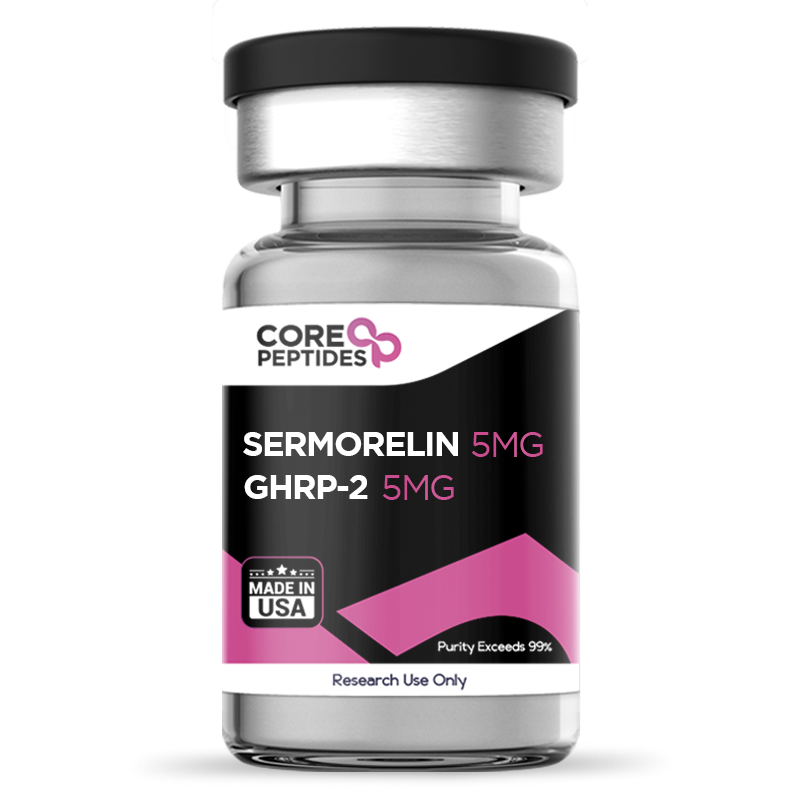
Sermorelin & GHRP-2 Blend
Sermorelin is a research peptide made of 29 amino acids that is a truncated version of the full 44-aa length endogenous Growth Hormone-Releasing Hormone (GHRH). Sermorelin is considered the shortest functional analogue that contains the first 29 amino acids, and it is also amidated at the C-terminus. According to research by Clark et al., the peptide appears to retain its affinity to the GHRH receptors found in pituitary cells and activate them.(1) Thus, Sermorelin is considered a GHRH analog. GHRH receptors are the main receptors on pituitary cells that are considered to play a role in the synthesis of growth hormone.
Research by Berlanga-Acosta et al. describes GHRP-2 as a fully synthetic hexapeptide, developed from earlier GHRPs such as GHRP-6 and ultimately based on modified enkephalins (endogenous opioid pentapeptides).(2) It is engineered to favor growth hormone release rather than opioid activity, apparently by targeting ghrelin (growth hormone secretagogue) receptors instead of classical opioid receptors.
Because GHRP-2 and related GHRPs share this receptor system, they are broadly referred to as growth hormone secretagogues (GHSs). Researchers suggest that by targeting different pituitary receptors with the same potential, peptides like Sermorelin and GHRP-2 may have synergistic actions. Future research should elucidate this more thoroughly.
Chemical Makeup
Other Known Titles
- Sermorelin: GRF 1-29 NH2
- GHRP-2: pralmorelin
Molecular Weight:
- Sermorelin:93 g/mol
- GHRP-2:97 g/mol
Molecular Formula:
- Sermorelin: C149H246N44O42S
- GHRP-2: C45H55N9O6
Research and Clinical Studies
Sermorelin & GHRP-2 Actions on Pituitary Cells
Sermorelin appears to act primarily at GHRH receptors, which normally respond to endogenous GHRH. Work by Culhane et al. suggests that GHRH analogs may interact with the receptors via G-protein coupling, followed by cAMP production, and downstream growth hormone release. (3) Consequently, the upregulated growth hormone release may interact with growth hormone receptors in a variety of cells, which may synthesize a major anabolic mediator called insulin-like growth factor-1 (IGF-1).
By contrast, GHRP-2 is thought to target the ghrelin receptors, which are also known as growth-hormone secretagogue receptors. Specifically, these are the GHS receptors 1a. Research by Yin et al. has deeply investigated these receptors, and they posit that these are seven-transmembrane G-protein-coupled receptors.(4) The interaction may then trigger a chain of intracellular signals starting with an enzyme at the cell membrane called phospholipase C (PLC). PLC cuts a specific membrane fat molecule (PIP₂) into two smaller signaling molecules.
One molecule, called IP₃, moves into the fluid inside the cell and may ultimately bind to channels on internal calcium stores, causing Ca²⁺ to be released into the cytoplasm. The other fragment, called DAG, stays in the membrane and helps switch on another enzyme family called protein kinase C (PKC), which adds phosphate groups to selected proteins and thereby changes their activity. In combination, the temporary rise in intracellular calcium and the activation of PKC may activate the genes associated with growth hormone synthesis and also stimulate the release of growth hormone molecules out of the pituitary cells.
Sermorelin & GHRP-2 Potential on Somatotroph Growth Hormone Output
Vittone et al. explored the potential of Sermorelin on the growth hormone output capacity of pituitary cells and suggest that the peptide may double it.(5) Specifically, the researchers commented that 12-hour mean growth hormone concentration increased from 1.1 ± 0.9 µg/L to 2.2 ± 1.9 µg/L, and the integrated growth hormone secretion over 12 hours. increased from 1114 ± 931 µg·min/L to 2032 ± 1728 µg·min/L.
This apparent increase in GH synthesis and release per pulse was accompanied by “no change in GH pulse frequency or in levels of IGF-I, IGFBP-3, or GHBR.” Nevertheless, the authors posited that local, tissue-level IGF-I production in targets such as skeletal muscle cells might still be modulated, even if overall IGF-I remains relatively stable. The researchers also posited that if muscle cells are exposed to the GH peaks induced by Sermorelin, this may be associated with better-supported muscle cell performance.
According to further research by Khorram et al., the majority of the increase in GH synthesis may be within the first 2 hours of the pituitary cells being exposed to Sermorelin.(6) The integrated 2-hour GH area observed by the authors apparently rose from about 200-300 to 1,100–1,600 µg·L⁻¹·min (roughly 6-fold). Additionally, this team of researchers also observed an increase in the IGF-1. Mean IGF-I rose apparently by about 27-28%.
According to the available research, such as experiments by Bowers et al., GHRP-2 may also upregulate growth hormone synthesis by pituitary cells.(7) Particularly in the case of continuous exposure for 24 hours, the peptide apparently led to an increase from roughly 20–30 µg·L⁻¹·24 h under placebo conditions to about 120–180 µg·L⁻¹·24 h with GHRP-2, implying an approximate 4- to 6-fold rise in growth hormone production.
This pattern is compatible with a sustained stimulatory action on growth hormone synthesis by pituitary cells and pulsatile release rather than a brief, desensitizing spike. In the same experiment, IGF-1 concentrations apparently rose from baseline values of about 90–100 µg/L to approximately 150–160 µg/L after the extended 24-hour GHRP-2 exposure. This data suggests that GHRP-2 may increase IGF-1 production by roughly 50–80%, creating a higher steady-state plateau of IGF-1.
Sermorelin & GHRP-2 Potential on Other Cells
In laboratory settings studied by Chatelain et al., upregulation of IGF-1 by peptides such as Sermorelin may extend beyond pituitary cells and growth hormone dynamics. It might potentially support Leydig cells and their main endocrine function, which is to synthesize testosterone.(8) The increased IGF-1 may act on Leydig cells via the IGF-1 receptor, which is thought to be present on these cells, and has been posited to support their responsiveness to gonadotropins.
Experimental data suggest that sustained elevations in growth hormone and IGF-1 may increase LH/hCG receptor density in Leydig cells and may raise hCG-stimulated hormonal output per cell, specifically the hormone testosterone. This pattern is compatible with the possibility that IGF-1 modulates transcription, translation, or membrane trafficking of LH/hCG receptors, thereby amplifying gonadotropin signaling at the Leydig cell surface.
In parallel, IGF-1 may also promote expansion of Leydig cell mass and/or support their functional maturation, perhaps through modest mitogenic or differentiation-supporting pathways. However, these mechanisms remain hypothetical and would require targeted verification in controlled laboratory models. Experimental work with GHRP-2 also suggests that this peptide may interact with receptors outside pituitary cells. Specifically, research by Granado et al. suggests that the peptide may modulate liver-associated immune cells during an inflammatory challenge with lipopolysaccharide (LPS).(9) In LPS-stimulated hepatocyte–nonparenchymal cocultures, GHRP-2 apparently reduced TNF-α mRNA and nitrite/nitrate release, which are important inflammatory markers.
Researchers like these also tend to express through their research the theory that GHRP-2 may act primarily on nonparenchymal immune cells (such as Kupffer or Kupffer-like macrophages) rather than directly on hepatocytes. Separate lines of research have proposed that GHRP-type peptides may bind CD36 on macrophages, so it is plausible that, in such models, GHRP-2 may signal via CD36 on these immune cells, dampening LPS-driven activation programs that lead to TNF-α and inducible nitric oxide synthase induction. The downstream normalization of nitric oxide and cytokine output may then secondarily interact with neighboring hepatocytes in cell cultures, including their IGF-I expression.
Sermorelin & GHRP-2 Synergistic Potential
The already mentioned work in experimental pituitary systems by Bowers et al. has explored how GHRP-2 may behave when combined with endogenous GHRH. They observed that simultaneous exposure to GHRP-2 and unmodified GHRH may raise integrated 24-hour growth hormone output from baseline values of roughly 20–30 µg·L⁻¹ to about 238 ± 28 up to 452 ± 106 µg·L⁻¹.
These findings correspond to an apparent ~16-fold elevation over baseline GH exposure and more than a twofold increase compared with GHRP-2 alone. Thus, the concurrent activation of the GHS-R1a and the GHRH receptor on pituitary cells may exert synergistic actions to generate a markedly amplified growth hormone secretion in laboratory settings. The researchers also concluded that the “combined GHRP-2 and GHRH drive is more effective than either agonist alone.”
Laboratory work by Veldhuis et al., using a similar experimental setting, also points to a potentially synergistic interaction between GHRP-2 and full-length GHRH at the level of pituitary cell cultures. In their experimental models, GHRH alone was estimated to increase growth hormone burst by roughly 20-fold over baseline, whereas GHRP-2 alone was associated with an even larger 47-fold rise. When both secretagogues were present together, the calculated response increased to around 54-fold above saline, which was on the order of 10–15% higher than GHRP-2 alone. This pattern is also compatible with the theory that while each peptide strongly activates somatotroph signaling on its own, combined receptor engagement may provide an additional amplification of growth hormone release.
By extension, the GHRH-analog Sermorelin should also exert synergistic potential when combined in experiments at the pituitary-cell level. To confirm this, a small clinical series by Sigalos et al. specifically investigated Sermorelin with GHRP-2 (plus an additional GHRP).(11) According to their data, the combination may drive a substantially stronger IGF-1 response than GHRP-2 alone. Apparently, Sermorelin, GHRP-2, and another GHRP increased IGF-1 from about 160 ng/mL at baseline to roughly 250–265 ng/mL. This is interpreted as roughly a 50–70% rise and a clear upward shift within the reference range.
These data points are compatible with the notion that dual-pathway stimulation of pituitary somatotrophs may produce a markedly greater IGF-1 increase than either peptide alone. However, this study is not able to prove superiority because it lacked adequate levels of experimentation.
Sermorelin & GHRP-2 blend is available for research and laboratory purposes only. Please review our Terms and Conditions before ordering.
References:
- Clark RG, Robinson IC. Growth induced by pulsatile infusion of an amidated fragment of human growth hormone releasing factor in normal and GHRF-deficient rats. Nature. 1985 Mar 21-27;314(6008):281-3. doi: 10.1038/314281a0. PMID: 2858818.
- Berlanga-Acosta J, Abreu-Cruz A, Herrera DGB, Mendoza-Marí Y, Rodríguez-Ulloa A, García-Ojalvo A, Falcón-Cama V, Hernández-Bernal F, Beichen Q, Guillén-Nieto G. Synthetic Growth Hormone-Releasing Peptides (GHRPs): A Historical Appraisal of the Evidences Supporting Their Cytoprotective Effects. Clin Med Insights Cardiol. 2017 Mar 2;11:1179546817694558. doi: 10.1177/1179546817694558. PMID: 28469491; PMCID: PMC5392015.
- Culhane KJ, Liu Y, Cai Y, Yan EC. Transmembrane signal transduction by peptide hormones via family B G protein-coupled receptors. Front Pharmacol. 2015 Nov 5;6:264. doi: 10.3389/fphar.2015.00264. PMID: 26594176; PMCID: PMC4633518.
- Yin Y, Li Y, Zhang W. The growth hormone secretagogue receptor: its intracellular signaling and regulation. Int J Mol Sci. 2014 Mar 19;15(3):4837-55. doi: 10.3390/ijms15034837. PMID: 24651458; PMCID: PMC3975427.
- Vittone J, Blackman MR, Busby-Whitehead J, Tsiao C, Stewart KJ, Tobin J, Stevens T, Bellantoni MF, Rogers MA, Baumann G, Roth J, Harman SM, Spencer RG. Effects of single nightly injections of growth hormone-releasing hormone (GHRH 1-29) in healthy elderly men. Metabolism. 1997 Jan;46(1):89-96. doi: 10.1016/s0026-0495(97)90174-8. PMID: 9005976.
- Khorram O, Laughlin GA, Yen SS. Endocrine and metabolic effects of long-term administration of [Nle27]growth hormone-releasing hormone-(1-29)-NH2 in age-advanced men and women. J Clin Endocrinol Metab. 1997 May;82(5):1472-9. doi: 10.1210/jcem.82.5.3943. PMID: 9141536.
- Bowers, C. Y., Granda, R., Mohan, S., Kuipers, J., Baylink, D., & Veldhuis, J. D. (2004). Sustained elevation of pulsatile growth hormone (GH) secretion and insulin-like growth factor I (IGF-I), IGF-binding protein-3 (IGFBP-3), and IGFBP-5 concentrations during 30-day continuous subcutaneous infusion of GH-releasing peptide-2 in older men and women. The Journal of clinical endocrinology and metabolism, 89(5), 2290–2300. https://doi.org/10.1210/jc.2003-031799
- Chatelain PG, Sanchez P, Saez JM. Growth hormone and insulin-like growth factor I treatment increase testicular luteinizing hormone receptors and steroidogenic responsiveness of growth hormone deficient dwarf mice. Endocrinology. 1991 Apr;128(4):1857-62. doi: 10.1210/endo-128-4-1857. PMID: 2004605.
- Granado M, Martín AI, López-Menduiña M, López-Calderón A, Villanúa MA. GH-releasing peptide-2 administration prevents liver inflammatory response in endotoxemia. Am J Physiol Endocrinol Metab. 2008 Jan;294(1):E131-41. doi: 10.1152/ajpendo.00308.2007. Epub 2007 Nov 6. PMID: 17986630.
- Veldhuis JD, Keenan DM. Secretagogues govern GH secretory-burst waveform and mass in healthy eugonadal and short-term hypogonadal men. Eur J Endocrinol. 2008 Nov;159(5):547-54. doi: 10.1530/EJE-08-0414. Epub 2008 Aug 14. Erratum in: Eur J Endocrinol. 2008 Dec;159(6):841. PMID: 18703567; PMCID: PMC2680123.
- Sigalos JT, Pastuszak AW, Allison A, Ohlander SJ, Herati A, Lindgren MC, Lipshultz LI. Growth Hormone Secretagogue Treatment in Hypogonadal Men Raises Serum Insulin-Like Growth Factor-1 Levels. Am J Mens Health. 2017 Nov;11(6):1752-1757. doi: 10.1177/1557988317718662. Epub 2017 Aug 22. PMID: 28830317; PMCID: PMC5675260.
Dr. Marinov
Dr. Marinov (MD, Ph.D.) is a researcher and chief assistant professor in Preventative Medicine & Public Health. Prior to his professorship, Dr. Marinov practiced preventative, evidence-based medicine with an emphasis on Nutrition and Dietetics. He is widely published in international peer-reviewed scientific journals and specializes in peptide therapy research.