CJC-1295 (no DAC) & Hexarelin
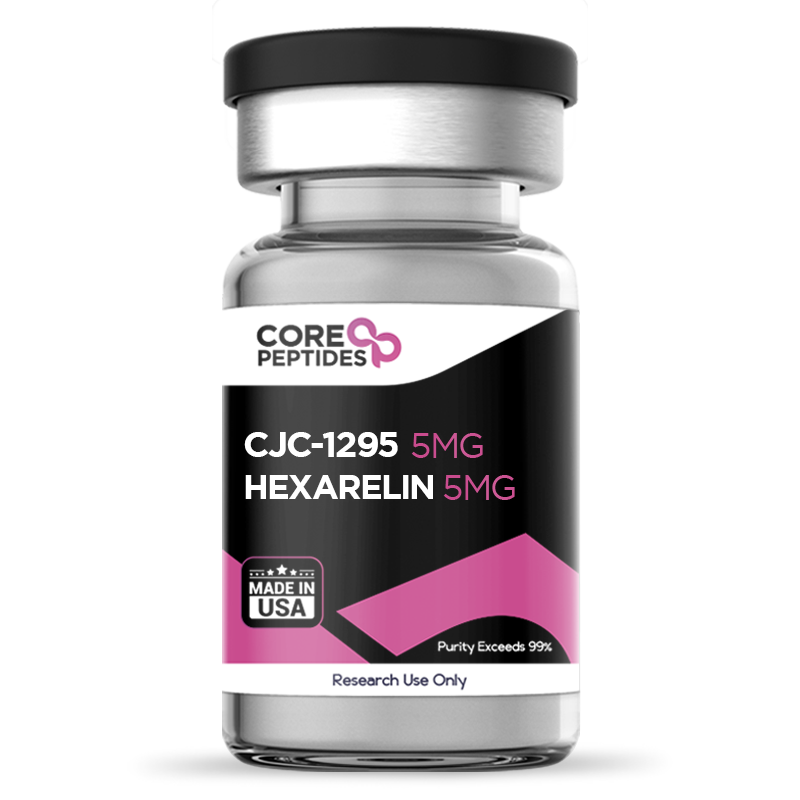
CJC-1295 (no DAC) and Hexarelin are research peptides that have been studied by researchers in the interest of learning more about growth hormone synthesis by pituitary cells. Many relevant scientific observations have been drawn from such studies. Specifically, these peptides appear to interact with different receptors on anterior pituitary gland cells and stimulate the synthesis and release of this hormone.
Rather than interacting via the same receptors, CJC-1295 (no DAC) and Hexarelin belong to different classes of research peptides that interact with pituitary cells via different receptors. Previous research has suggested that simultaneous activation of both receptor types may initiate synergistic actions; hence, the combination of CJC-1295 (no DAC) and Hexarelin may be of interest to scientists.
Chemical Makeup
Other Known Titles
- CJC-1295 (no DAC): Modified GRF 1-29
- Hexarelin: Examorelin, P-23905, and MF-6003
Molecular Weight:
- CJC-1295 (no DAC):9 g/mol
- Hexarelin:05 g/mol
Molecular Formula:
- CJC-1295 (no DAC): C152H252N44O42
- Hexarelin: C47H58N12O6
Research and Clinical Studies
CJC-1295 (no DAC) Interactions with GHRH Receptors
CJC-1295 (no DAC) and Hexarelin appear to interact with pituitary cells via different receptors. CJC-1295 (no DAC) may interact with the cells via the GHRH receptor, which is posited to be the main type of receptor on these cells regulating growth hormone synthesis. Normally, these receptors respond to the endogenous growth hormone-releasing hormone (GHRH), which has a 44-amino-acid structure.
Researchers believe CJC-1295 (no DAC) may mimic that structure. This is suspected in part because the peptide consists of the first 29 amino acids from GHRH with four specific modifications. The first 29 amino acids are posited to retain a GHRH-receptor affinity while being a shorter molecule. Specifically, this is considered by said researchers to be the shortest molecule that may stimulate growth hormone release via the GHRH receptors.
To further support the potential of CJC-1295 (no DAC), the peptide bears four modifications, which, according to researchers such as Jette et al., involve the amino acids at positions 2, 8, 15, and 27.(1) Specifically, the modifications involve replacements at:
- At position 2, alanine is replaced with D-alanine, which may make the peptide less susceptible to common proteolytic enzymes.
- At position 8, asparagine is replaced with lysine, introducing an extra positive charge that may subtly change the surface charge and potentially support stronger interaction with the GHRH receptor.s
- At position 15, histidine is replaced with D-phenylalanine, adding a second D-amino acid that may further slow enzymatic degradation.
- At position 27, cysteine is replaced with N-methylglycine (sarcosine), which may hinder specific peptidases from rapidly dismantling the peptide backbone.
This may allow the peptide to remain active for longer and to produce a more sustained receptor signal, possibly. Despite these changes, the downstream signaling is thought to resemble that of endogenous GHRH. The peptide is hypothesized to activate adenylyl cyclase, leading to the conversion of ATP into cyclic AMP (cAMP).
Rising cAMP levels may then activate protein kinase A, which is proposed to phosphorylate targets that open voltage-dependent calcium channels on pituitary somatotroph membranes. The resulting calcium influx may trigger vesicle fusion and promote the release of stored growth hormone. Apart from upregulating growth hormone release, the peptide may also upregulate the overall capacity for growth hormone synthesis.
An experiment by Alba et al. suggests the peptide “caused an increase in total pituitary RNA and GH mRNA, suggesting that proliferation of somatotroph cells had occurred, as confirmed by immunohistochemistry images.”(2) This pattern suggests that the peptide may also potentially support somatotroph number and GH gene transcription.
Hexarelin Interactions with GHS-R1a
Rather than a GHRH analog, Hexarelin has been referred to by experts as a growth hormone secretagogue (GHS). This is a class of peptides that react with pituitary cells via a different set of receptors called the growth hormone secretagogue receptors 1a (GHS-R1a). Experimental work undertaken in laboratory settings by Bowers et al. and Yin et al. has suggested that GHS-R1a is also the main receptor for ghrelin, also referred to as the hunger hormone.(3)(4) When Hexarelin binds to these receptors, it may trigger a signaling cascade that looks different from GHRH-type peptides.
One potential pathway involves activation of phospholipase C, which may then generate two second messengers: IP₃ and diacylglycerol (DAG). IP₃ is thought to release calcium from intracellular stores. At the same time, diacylglycerol may activate protein kinase C. Higher intracellular calcium, together with PKC activation, is then posited to support growth hormone release from somatotroph cells. Thu, the peptide appears to induce the release of growth hormone by a different mechanism, potentially complementary to those of GHRH-analogs like CJC-1295 (no DAC).
CJC-1295 (no DAC) & Hexarelin Potential on Hormone Synthesis
Experiments suggest that the growth hormone release induced by CJC-1295 (no DAC) & Hexarelin from pituitary cells may surpass the peaks typically observed in control settings. For example, an experiment with CJC-1295 (no DAC) by Khorram et al. suggests that this kind of peptide may raise growth hormone output from pituitary cells by roughly 70–100% over a 12-hour window in laboratory settings.(5) The authors observed the most pronounced peak in the first two hours after exposure.
In their report, 2-hour integrated growth hormone secretion seemed to rise approximately 6-fold from about 200–300 to roughly 1,100–1,600 µg/L·min. Growth hormone released in this way may then bind to GH receptors on peripheral cells and possibly drive IGF-1 production, which is viewed as a key downstream mediator of growth hormone’s anabolic actions. In that experiment, mean IGF-1 levels appeared to increase by around 27% after prolonged CJC-1295 (no DAC) exposure.
Similarly, research by Imbimbo et al. has suggested that Hexarelin itself may drive an increase in growth hormone release from pituitary cells. Compared with a baseline near 3.9 ng/mL under placebo conditions, Hexarelin seemed to push peak growth hormone levels up to about 55 ng/mL, where the response plateaued. The maximal stimulus appeared within 30–40 minutes, followed by a gradual fall back toward baseline over about four hours, with an estimated half-life in the range of 50–60 minutes. This pattern suggests a strong but short-lived growth hormone pulse after Hexarelin exposure. The scientists also observed that “plasma glucose, luteinising hormone, follicle-stimulating hormone, thyroid-stimulating hormone” were unaffected.
CJC-1295 (no DAC) & Hexarelin Synergistic Potential
Currently, there are no experiments conducted in laboratory settings that have evaluated a combination of CJC-1295 (no DAC) & Hexarelin. Yet, the research that is available has investigated blends between Hexarelin and other GHRH-analogs, such as the full-length GHRH, from which CJC-1295 (no DAC) is derived at length. Notably, several studies by Arvat et al. evaluated GHRH and Hexarelin individually or in a blend, and suggest that when pituitary cells are exposed simultaneously to Hexarelin and GHRH, activating both types of receptors may exert synergistic actions.(7)
When each compound was exposed to research models alone, Hexarelin appeared to generate a much larger growth hormone synthesis measured as an area under the curve (about 2,200.8 ± 256.9 µg/L·h) than GHRH by itself (around 792.2 ± 117.6 µg/L·h). However, when both were combined, the reported growth hormone area under the curve rose to roughly 4,259.2 ± 308.0 µg/L·h. This is higher than the sum of the two single-agent responses, which the authors interpreted as a true synergistic potential. Taken together, findings like this are often viewed by researchers as potentially suggestive that a GHRH-type peptide and a GHS like Hexarelin may provide a stronger pituitary GH signal when both receptor systems are engaged at the same time.
CJC-1295 (no DAC) & Hexarelin blend is available for research and laboratory purposes only. Please review our Terms and Conditions before ordering.
References:
- Jetté L, Léger R, Thibaudeau K, Benquet C, Robitaille M, Pellerin I, Paradis V, van Wyk P, Pham K, Bridon DP. Human growth hormone-releasing factor (hGRF)1-29-albumin bioconjugates activate the GRF receptor on the anterior pituitary in rats: identification of CJC-1295 as a long-lasting GRF analog. Endocrinology. 2005 Jul;146(7):3052-8.DOI: 10.1210/en.2004-1286. Epub 2005 Apr 7. PMID: 15817669.
- Alba M, Fintini D, Sagazio A, Lawrence B, Castaigne JP, Frohman LA, Salvatori R. Once-daily administration of CJC-1295, a long-acting growth hormone-releasing hormone (GHRH) analog, normalizes growth in the GHRH knockout mouse. Am J Physiol Endocrinol Metab. 2006 Dec;291(6):E1290-4. doi: 10.1152/ajpendo.00201.2006. Epub 2006 Jul 5. PMID: 16822960.
- Bowers CY. History of the discovery of ghrelin. Methods Enzymol. 2012;514:3-32. doi: 10.1016/B978-0-12-381272-8.00001-5. PMID: 22975043.
- Yin Y, Li Y, Zhang W. The growth hormone secretagogue receptor: its intracellular signaling and regulation. Int J Mol Sci. 2014 Mar 19;15(3):4837-55. doi: 10.3390/ijms15034837. PMID: 24651458; PMCID: PMC3975427.
- Khorram O, Laughlin GA, Yen SS. Endocrine and metabolic effects of long-term administration of [Nle27]growth hormone-releasing hormone-(1-29)-NH2 in age-advanced men and women. J Clin Endocrinol Metab. 1997 May;82(5):1472-9. doi: 10.1210/jcem 82.5.3943. PMID: 9141536.
- Imbimbo BP, Mant T, Edwards M, Amin D, Dalton N, Boutignon F, Lenaerts V, Wüthrich P, Deghenghi R. Growth hormone-releasing activity of hexarelin in humans. A dose-response study. Eur J Clin Pharmacol. 1994;46(5):421-5. doi: 10.1007/BF00191904. PMID: 7957536.
- Arvat E, Di Vito L, Gianotti L, Ramunni J, Boghen MF, Deghenghi R, Camanni F, Ghigo E. Mechanisms underlying the negative growth hormone (GH) autofeedback on the GH-releasing effect of hexarelin in man. Metabolism. 1997 Jan;46(1):83-8. doi: 10.1016/s0026-0495(97)90173-6. PMID: 9005975.
- Arvat, E., Gianotti, L., Di Vito, L., Imbimbo, B. P., Lenaerts, V., Deghenghi, R., Camanni, F., & Ghigo, E. (1995). Modulation of growth hormone-releasing activity of hexarelin in man. Neuroendocrinology, 61(1), 51–56. https://doi.org/10.1159/000126827
Dr. Marinov
Dr. Marinov (MD, Ph.D.) is a researcher and chief assistant professor in Preventative Medicine & Public Health. Prior to his professorship, Dr. Marinov practiced preventative, evidence-based medicine with an emphasis on Nutrition and Dietetics. He is widely published in international peer-reviewed scientific journals and specializes in peptide therapy research.